
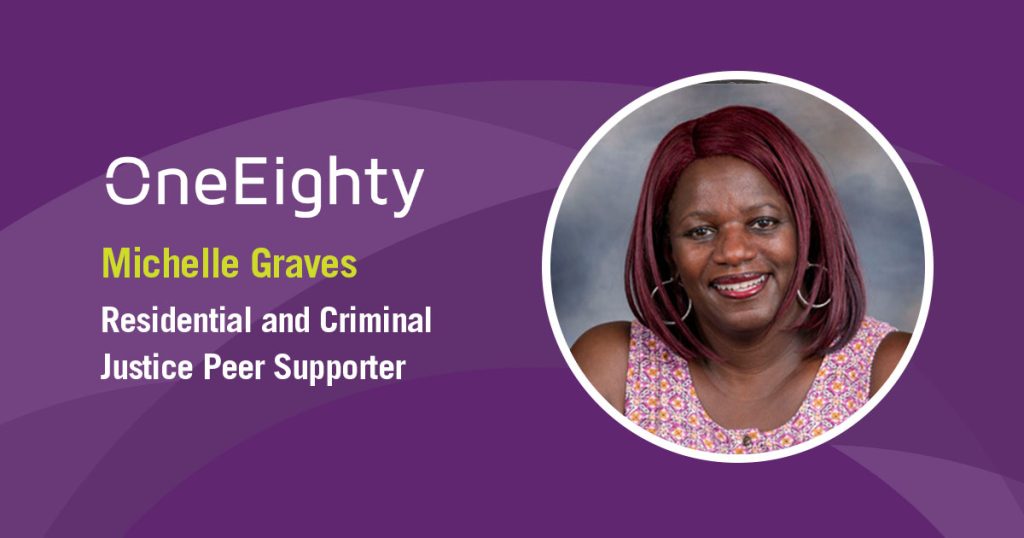
How Lived Experience Saves Lives: Honoring Michelle Graves’ 18 Years at OneEighty
Article Highlights
After 18 years of transformative service, OneEighty celebrates the retirement of Michelle Graves, a beloved Residential and Criminal Justice Peer Supporter. Discover how her own lived experience helped save lives, bridge gaps in our levels of care, and prove that no one has to walk the recovery path alone.
Walking the Path of Recovery
When Michelle Graves first walked through the doors of OneEighty eighteen years ago, back when we were still known as Liberty Center Connection, she thought she was stepping into a simple babysitting job. She had just lost her previous role as a nurse’s aide and was a single mom to three kids, going to school full-time, and running on pure exhaustion. She needed a fresh start.
She got her interview on a Friday and started training at Julia’s Place, the domestic violence shelter at OneEighty, the following Monday. What she didn’t realize at the time was that she was not just starting a new job; she was stepping directly into her life’s purpose.
Today, as Michelle prepares for her well-deserved retirement, the OneEighty community looks back on a career defined by unconditional love, deep-rooted empathy, and lives completely transformed.
From Babysitter to Life Saver: Finding a Purpose in Peer Support
Early on, Michelle was asked to fill in at our men’s residential treatment facility. “When I took it on, and he showed me everything, I said, ‘Oh, I got a babysitting job,'” Michelle laughs. “I gotta be here to make sure that they don’t sneak the women in the house past me, they don’t bring any drugs in, and they stay sober.”
But it didn’t take long for Michelle to realize the clients didn’t need a babysitter. They needed someone who truly understood the heavy weight of addiction. At the time, the agency didn’t even know that Michelle was a person in long-term recovery. It simply wasn’t something people talked about openly back then.
Everything changed one afternoon when an older gentleman, out of sheer frustration, packed up and was ready to leave the facility. “I said, ‘Well, let’s have a conversation,'” Michelle recalls. “He sat down, and we talked. I told him my story, and I had a real conversation with this man. He cried, and I cried, and he ended up staying. The next day, all those guys were lined up at my desk wanting to have a conversation.”
That was the catalyst. Michelle went on to spend a decade working deeply within our residential houses before officially earning her certification in peer support services. She realized she did not have to choose between helping the men or the women; her unique voice was needed everywhere.
Bridging the Gap in Criminal Justice Peer Support
As OneEighty expanded its addiction treatment levels of care, Michelle’s role evolved into something incredibly specialized: criminal justice peer support. She began marching right into jails and courtrooms, meeting with probation officers and standing shoulder to shoulder with clients who felt abandoned by the world. “I really enjoyed that time when I was in jail, knowing that there were people who were looking for help that didn’t know which direction to turn,” Michelle says. “Just knowing that peer support was inside there and we could let them know that they weren’t alone. One of the things that I would often tell my clients is, ‘You know, sometimes we make the choice to want to change, sometimes we are forced to change. However the change happens, it only makes our lives better.’”
For Michelle, providing lived experience recovery support meant looking at the whole person, not just a rap sheet or a chemical dependency. She quickly saw that a revolving door in the justice system usually meant a piece of the puzzle was missing, specifically mental health.
“Our job as a peer support is to be there, allowing somebody to know they have support in their recovery. This includes both substance abuse and mental health support. We have to be able to see the whole picture. Don’t give up and don’t be so quick to count them out. When you take care of the whole person, and the person starts to feel like a person again, the chances of their successes are so much higher.”
A Legacy of Believing in People
If you ask Michelle what a successful day at work looks like, she will tell you it is the exact moment when the light bulb comes on inside a client’s mind. It is that beautiful breakthrough when someone finally says they believe in themselves and they can do the hard work.
Her belief in others has created a massive ripple effect across the region. She recalls a former client who told Michelle she wished she could become a professional counselor. “I looked at her, and I said, ‘You can.’ She completed treatment, enrolled in school, got her degree, and she became a counselor. I knew she could do it.”
Another one of Michelle’s former clients was so inspired by the care kits Michelle put together that she went on to launch her own independent nonprofit organization. Today, that organization partners with nine different local agencies to provide welcome bags to people entering recovery.
At a recent retirement celebration hosted by her coworkers, another peer supporter admitted they knew exactly who Michelle was long before they started at OneEighty, simply because her reputation among clients was so legendary.
Words from the Heart: Michelle’s Message Board
At her retirement celebration, coworkers and clients filled a message board with handwritten notes. The board quickly overflowed with an outpouring of love from the people who know her best.
When you read through the notes, you see a beautiful snapshot of what Michelle brought to OneEighty every single day:
- “Ms. Michelle had the heart and patience to work with the most difficult clients. Her compassion for this work was like no one else.”
- “Ms. Michelle, where do I begin? You have been the biggest supporter of my life during this addiction journey.”
- “When Michelle spoke, people listened. She had a way with people.”
- “I remember when I was having a rough day and she brought me a birthday lunch. You are a beautiful human being and friend. I will miss your smile and positivity.”
- “Co-working to support peers. Her devotion to work with clients’ best interest. Thank you for the impact you have made on all of us. You have inspired me to be the best I can.”
The Next Chapter
While Michelle says she can’t entirely see herself sitting still for long, she is looking forward to a schedule with absolutely no limits. Her immediate plans include some well-deserved travel to North Carolina, Alabama, and Atlanta to visit her sister.
Before she packs up her office, Michelle has one final message for the coworkers, clients, and neighbors who have filled her life with so much meaning. “To this agency, to this community, I say thank you. Thank you for allowing me to be me in this setting. Thank you for accepting me for who I am. Just thank you.”
Michelle answered her purpose, saved countless lives, and the OneEighty family will be forever grateful.
Learning More About Peer Support at OneEighty
Michelle’s incredible 18-year career shows just how vital peer support services are to our mission. If you’re curious about how these programs integrate into our addiction treatment levels of care, here are a few frequently asked questions about how we work.
Frequently Asked Questions (FAQs)
What are peer support services in addiction treatment? Peer support services involve individuals in long-term recovery using their own lived experience with substance use or mental health challenges to support, encourage, and guide others currently going through treatment.
What does a criminal justice peer supporter do? A criminal justice peer supporter bridges the gap between legal systems and recovery. They visit clients inside jails, accompany them to court hearings, coordinate with probation officers, and provide resources to help individuals successfully transition back into the community without reoffending.
Why does OneEighty offer different levels of care? Recovery is not a one-size-fits-all journey. OneEighty provides multiple levels of addiction treatment care, including crisis intervention, residential housing, outpatient counseling, and peer support, to ensure every individual receives the exact amount of medical, emotional, and social support they need at every stage of healing.
OneEighty Resources
For those encountering a substance use crisis, please call OneEighty’s Substance Use Crisis hotline, available 24 hours per day, 365 days per year, at 330-466-0678. For other resources, click the links below: